
What is an Electromagnet? How It Works and How to Choose One
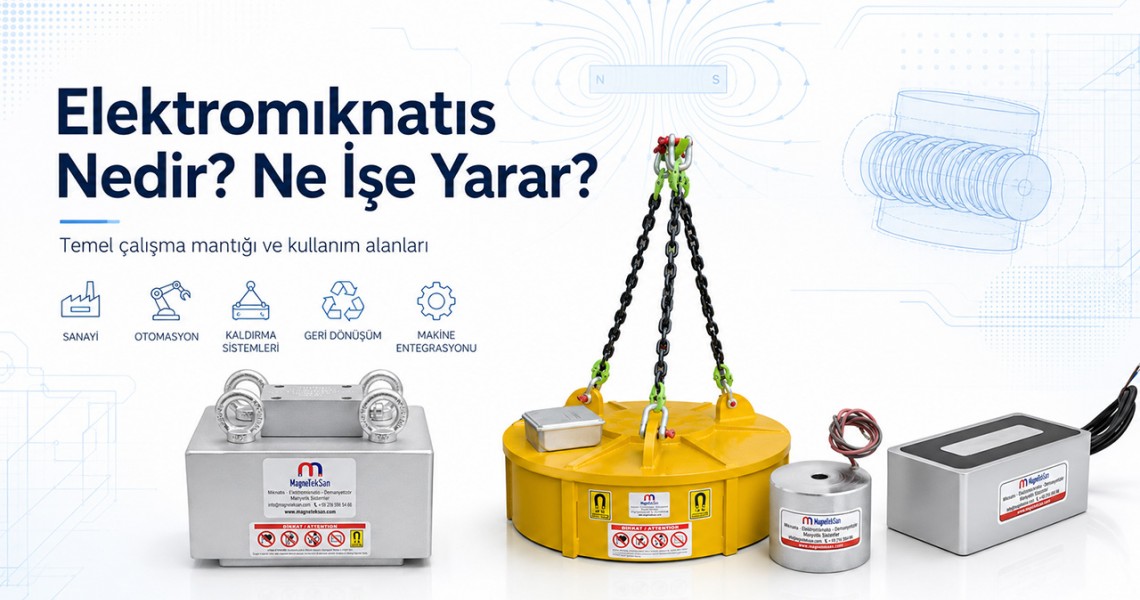
Short answer: An electromagnet is a magnet created by passing electric current through a coil wound around an iron core. It is strong while energised and releases when the current is switched off, which makes it ideal for lifting, holding, separation and automation.
How does an electromagnet work?
When direct current (DC) flows through a copper or aluminium coil, it produces a magnetic field. A soft-iron core concentrates this field so that the pole face acts as a strong magnet. When the current stops, the core loses most of its magnetism and the workpiece is released. Holding force depends on ampere-turns, core material and cross-section, the air gap at the contact surface, and the thickness and grade of the steel being held.
Electromagnet vs permanent magnet
Electromagnets can be switched and their force adjusted, but they need continuous power and release on power loss. Permanent (neodymium or ferrite) magnets hold without energy but cannot be switched off. Electro-permanent magnets combine both: a short pulse switches them on or off and they hold without power in between.
Where are electromagnets used?
- Scrap and load lifting under cranes
- Robot grippers, fixtures and conveyor automation
- Electromagnetic chucks for grinding and milling
- Door holders and fire-door release systems
- High-temperature handling in foundries and rolling mills
- Bells, relays, loudspeakers and electric motors
How to choose an electromagnet
Check the real load and contact surface (allow a 2–3x safety factor), the supply voltage (12/24 V DC or rectified mains), the duty cycle, power-failure safety for lifting applications, and whether a demagnetising controller is needed to remove residual magnetism. Custom sizes and forces can be manufactured on request.